Showing posts with label storytelling. Show all posts

Friday, December 2, 2011

Connecting with the Authors

11-11-11. I captured an entirely new perspective of Veterans Day this year when I had the chance to listen to the inspiration behind the intense writing of Poet Jehanne Dubrow at the College of Southern Maryland's Leonardtown Campus. Part of our "Connections" series to bring well-known writers up-close and personal with our community, that Veterans Day evening included a reading by Dubrow from her recent collection, "Stateside," as well as a student round table in which she candidly responded to their questions. I gathered the conversation into an interview that was featured this evening among the selections chosen for the Fall 2011 "Connections"  literary magazine published each semester through this program.

Although her poetry is centered on a military husband’s deployment, the collection is driven by intellectual curiosity and emotional exploration. The voice of the poetry experiences the deployment through the eyes of a spouse waiting at home, and Dubrow is described as fearless in her contemplation of the far-reaching effects of war on the homefront, and even more so in her excavation of a marriage under duress. Here's a sampling of the raw emotions she exposes as she reads "Nonessential Equipment."


During her hour-long conversation with the students and faculty who had spent the semester studying her work, Dubrow described the lack of a military spouse's voice in literature today. "If the military spouse perspective has never been represented in literature, what does that mean about the way we think about how difficult it is for a military spouse and how difficult it is to be a part of a military family? If that experience simply isn’t being given a voice, what does that say about us? Does that mean we just don’t want to hear about that voice or we don’t think it matters? Or that military spouses should just be quiet and suck it up?"

Through questioning, Dubrow described how she began her writing career when she was managing coffee shops and challenged herself to write a sonnet daily. The results she described as some really bad sonnets, but the practice and discipline were worth the effort although not monetarily, cautioning, “You don’t become a poet for the money.”
 
Dubrow's observation gave me pause and offered a point for me to make tonight as I offered the reporting perspective of writing with the other magazine contributors. Among those poets, photographers and short-story authors who like Dubrow bring a literary freedom to their creative works are Geralyn Adams, Judith Allen-Leventhal, Julian Cooperman, Tabor Elisabeth Flickinger, Allison Gragg, Rachel Heinhorst, Robin Karis, William Poe, Lisa Presgraves, Kate Richardson, Chris Rubenstahl, Tyler Scott, Linda Cooke Smith, Dee Sydnor, Paul Toscano, Joanne Van Wie, Joyce Vincent, Shannon Wilder, Brett Worrell and Brittany Yee.

As Dubrow noted, money isn't the allure of being a poet, and from my perspective, neither does a byline lure your into PR. As a reporter, my bylines were common, and delightfully so for this Connections feature as well, but those days are infrequent within PR since pieces are written from the organization's voice, not an individual's.

I still love writing regardless if I get the credit. In PR, the joy comes for me from searching out an individual's story, then sharing it, as I've done in the interview in the Connections magazine. Dubrow would say you become a poet because "poetry chooses you;" for me, I became a writer because storytelling chose me.

Click on this link if you're interested in previous author interviews and upcoming CSM's Connections programs. If the video link above doesn't open, use this link: http://youtu.be/fmCeHRYJhNc.

Tuesday, October 25, 2011

No news is ... still news

Shared by Editor & Publisher in its daily e-newsletter , Aug. 4, 2011
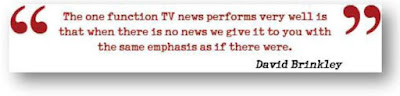
David Brinkley, whose career spanned 1943 to 1997, ranks right up there among the most trusted voices and journalists in America. His nightly reports on ABC and NBC spanned wars, a moon landing, presidential conventions, and, in his own words*, "2,000 weeks of news." 
In his heyday and my childhood days, news wasn't instantaneous via a tweet or immediately viral via a posting on Facebook or other favorite social network. Instead, our family read it in the Dispatch or waited for the 6 o'clock evening news. Credit cable networks for introducing us to 24/7/365 news in the 1980s.

Brinkley understood the passion of sharing news, and was among the best and most intense of storytellers. With the non-stop cycle in which we indulge today, we can as well share that passion of news. At our fingertips. Immediately. As a consumer or as an originator. In 140 characters. To click to read later or to share with our circle. To blog or leave comment on.

Brinkley's quote gives several questions with regard to news today. Does hyping all news with the same intensity skyrocket stress levels? If we overindulge in a steady stream of news, will the overabundance numb its impact or instead lead us to become news connoisseurs?

The news consumer ultimately judges the worth of the news, nosing out the trivial from the catastrophic. Case in point, here are two examples of posts on my feeds from the past 12 hours: Thought that night would never end. Finally home vs. Death toll from Turkey earthquake rises to over 400 as 2 week old baby is found alive in the rubble. The first is an opinion, the second a fact. The former raises further questioning since the reader is left uncertain what catastrophe the author returned home from: a flat tire? Horrendous traffic? A seemingly endless meeting? A dinner date gone awry? Whatever the cause, the individual is likely not commenting as a survivor of the earthquake. Yet, the emphasis, as Brinkley reminds us, is just as intense as if that were the situation.

It's our role as the author to understand the emotion of our words, and in today's non-stop cycle, let's put our words in perspective. The intensity of the storyteller shouldn't overshadow the intensity of the story. Our goal as the consumer is to understand the difference.


*as cited in One Man's America (2008), George F. Will, Random House, p. 118 (Chapter 15, Lingerie and Duct Tape) : ISBN 0307407861 9780307407863

Tuesday, July 26, 2011

Capturing the Blue Dog...sort of


Artist Don Zimmer's blue dog


The legend of the Blue Dog has captivated me for years. The story is one I learned shortly after moving into Charles County and connecting with local artist Joan Sutton Wooddy and her husband Dr. Arthur O. Wooddy. They had published a children's book filled with her drawings of the blue tick hound who haunted Port Tobacco's Rose Hill, mourning the loss of his master who was murdered at the hand of robbers seeking his gold one cold February night.


Courtesy of College of Southern Maryland Library


The story caught my imagination and several years later I had the opportunity to interview Connie Stuart, the owner of Rose Hill, as part of a feature article I wrote for the Times-Crescent newspaper. She weaved the story for me as well, taking me and the paper's photographer, Augie Selckmann, to the location where the legendary murder was to have occurred. That was 20 years ago.

What strikes me today is that legends live on, generation to generation, only because someone takes the time to hand it along. That's the case with the Blue Dog, whose legend now thrives today at The Blue Dog Saloon, courtesy of Artist Don Zimmer and Chef Gary Fick. Longtime friends, Gary approached Don when patrons kept asking Gary after he took over the restuarant if he was going to change its name. Not a chance, he shares here.


Gary found a willing partner in Don to tell the story. Having been away from painting for more than a decade, Don found inspiration quickly and the story came to life. Soon the project took on epic proportions and the four-foot-by-six-foot canvas laid claim to his living room, graciously turned over to the project by his wife, Sheri. A storyteller on numerous fronts (he just authored and released "Leadership and Listening: Spiritual Foundations for Church Governance"), Don was able to visually cast an image that captures the heart and soul of this more than 200-year-old legend.


Together, Don and Gary hung the painting in The Blue Dog Saloon's dining room the evening of July 26. Wthin minutes after settling it on the brick wall, patrons were drawn to it, captured by the story unfolded in the snowy February scene as moonlight floods across the dog, a tear glistening in the corner of his eye.

Don describes the contemporary scene he created, "Several accounts say that what we now refer to as the 'blue dog' was in fact an English Mastiff or simply a Mastiff. The Mastiff is one of the heaviest dog breeds with males sometimes exceeding 200 pounds. Like other Mastiffs, he is a gentle giant, self confident, watchful and patient. Intelligent and dignified, Mastiffs rarely bark, preferring instead to simply place themselves between any threat to their family and their family¹s things. The dog in the painting continues to guard his master¹s possessions and mourn for him. I have chosen to paint a contemporary winter night scene with a full moon and snow cover to accentuate the light and to use the trees introduce an element of eeriness. The stories talk of a dark Mastiff. The mark on the forehead is a wound from the assailants. Several accounts associate the alleged treasure's location with a holly tree; others talk about a rock. The dog is lying with a leather bag and folio next to large snow covered rock, which bears what people have said, is a paw print (now covered with snow). The dog is surrounded by holly.... The ravine that extends back into the distance on the left of the painting leads down to the existing Rose Hill Road. Route 6 is in the far background, La Plata is out of view on the left, Port Tobacco out of view on the right."


What story do you have to share? We all have one. For you, perhaps it's a story that reflects the values of your organization to help a newcomer appreciate the culture. Perhaps it's a story of courage that can help sharpen the leadership skills of a young manager. Or perhaps it's a story of your ancestors that will help your children understand their heritage. Whatever your story, you are its keeper, and its longevity into future generations rests on your storytelling. Don't let the story stop with you.